
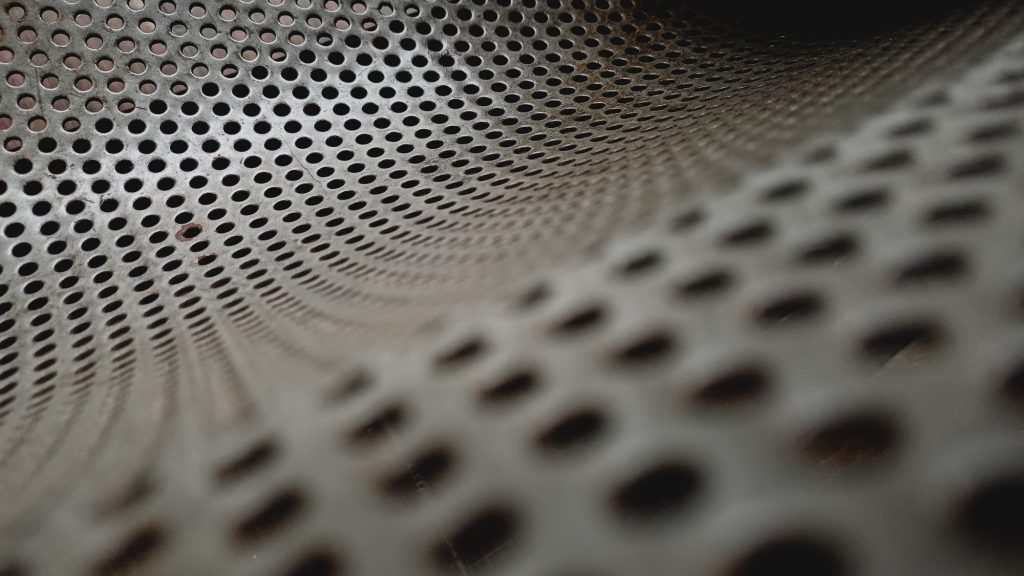
You can’t process complex sheet metal components for the energy and industrial markets today without running into jobs that require high-precision perforations.
Whether for engineering airflow, fluid filtration, reducing weight, or achieving highly specific structural integrity, perforated designs go a bit beyond simple holes punched into a sheet of metal. When our customers are working with such advanced functional performance properties and end processes, every hole has to be punched with absolute precision.
Designing for Airflow Without Compromise
In many of the applications we support, engineered airflow is a defining performance requirement. Whether it is a wind turbine nacelle ventilation panel or a solar inverter enclosure, the ability to move air efficiently while protecting internal components directly impacts system reliability.
Precision punching allows us to tightly control open area, hole size, spacing, and pattern geometry. This level of control enables engineers to fine-tune airflow rates and pressure drop characteristics without sacrificing enclosure strength.
For example, perforated airflow panels used in energy storage systems must balance thermal management with environmental protection. Too much open area can expose sensitive components. Too little can lead to overheating. By dialing in the perforation pattern, we help customers hit that performance window with confidence.
This same principle applies to hydrogen fuel cell component guards and enclosures, where airflow, safety, and durability all intersect.
Lightweighting Through Intelligent Perforation
Weight reduction is another key driver, especially in applications where transportation, installation, or structural loading are factors. Rather than switching to thinner material and risking rigidity, perforation offers a more controlled approach to lightweighting.
By removing material in strategic patterns, we can significantly reduce overall weight while preserving strength where it matters. This is particularly valuable in:
- Wind turbine nacelle panels where excess weight affects overall system efficiency.
- Large industrial enclosures that must be transported and installed in sections.
- Structural panels that need to maintain stiffness under load.
In many cases, perforation patterns are engineered to follow stress paths, ensuring that material is removed only where it will not compromise performance. This is where close collaboration between design engineers and fabrication teams makes a measurable difference.
Complex Patterns for Specialized Applications
Not all perforations are uniform grids. Many of the most effective designs involve complex or application-specific patterns that serve multiple functions at once.
- In industrial noise attenuators and silencers, perforation geometry directly influences acoustic performance. Hole size, distribution, and open area percentage all contribute to how sound waves are absorbed or redirected.
- For high-capacity fluid and gas strainers, perforated baskets or screens must maintain precise filtration characteristics while withstanding pressure and flow demands. Consistency in hole size and spacing is critical to avoid flow restrictions or premature failure.
- Custom fluidized bed plates used in dryers and powder coating systems present another layer of complexity. These plates require uniform air distribution across the entire surface to ensure even processing. Any variation in perforation can lead to inconsistent results.
- Similarly, in agricultural aeration floors and grain drying systems, perforation patterns must support both airflow efficiency and load-bearing requirements.
These are just a few of the critical components requiring perforations that we have experience with at RAM Specialty Fabrications.
Process Control and Repeatability
Achieving these outcomes consistently comes down to process control. Modern CNC punching equipment allows for high-speed, repeatable production of intricate patterns with tight tolerances.
Tooling selection, material behavior, and punch sequencing all play a role in the final result. For example, minimizing distortion and maintaining flatness is essential when working with large panels or thinner gauges.
At RAM, we also pay close attention to secondary effects such as burr formation and edge quality, particularly for applications where airflow or fluid movement is involved. Clean, consistent perforations translate directly into better performance in the field.
Where Precision Punching Delivers the Most Value
Across the energy and industrial sectors, precision sheet metal perforation proves its value in applications that demand performance, durability, and efficiency.
At RAM Specialty Fabrications, that includes some of the most advanced applications in energy, oil, gas, and industrial processing:
- Hydrogen fuel cell guards and enclosures requiring airflow and protection
- Solar inverter and ESS enclosures with thermal management needs
- Wind turbine ventilation panels balancing airflow and structural integrity
- Industrial silencers where perforation impacts acoustic performance
- Fluid and gas strainers requiring consistent filtration characteristics
- Fluidized bed plates needing uniform air distribution
- Agricultural aeration systems combining airflow and load support
Regardless of the end product or application, if it requires precision sheet metal punching, we can process it at RAM Specialty Fabrications.